CALIFORNIA BLUEBERRIES
  • Home
  • About Us
    • Market & Exports >
      • Handler Information
    • Industry Members >
      • CBC Business
    • Staff
  • Publications
    • Newsletters
    • Annual Reports
  • Research
  • Consumer
    • History
    • Education
    • Frequently Asked Questions
    • Recipes
    • Helpful Links
    • Meet Our Growers
  • B-MRIC
    • Grower Crop Estimate Survey
  • Export Market Database
  • Contact

Vietnam

Vietnam


​Export Requirements:
Shipments of U.S. blueberries shipped to Vietnam must be accompanied by an Import Permit (IP) and a Phytosanitary Certificate (PC). Shipments must follow the 2019 agreed upon work plan. USDA Animal and Plant Health Protection Inspection Service (APHIS) or APHIS-approved officials issue the required phytosanitary certificates..
Vietnam agreed to officially open their market for fresh U.S. blueberry imports on February 13, 2019.  As of June 25, 2019, Vietnam’s Plant Protection Department began issuing IPs for fresh blueberry fruit (Vaccinium corymbosum and Vaccinium virginatum, as well as Vaccinium corymbosum hybrids).  Requirements of the systems approach must be verified during the phytosanitary inspection at the registered packing facility. All California blueberry exporters who wish to ship to Vietnam must register and become certified by APHIS officials prior to the season. If a shipper previously registered and was added to the list, it is not necessary to repeat this process before each season. Please contact the Commission office for more information on this registered shippers list.
According to the 2019 fresh blueberry market access agreement, blueberries imported from the U.S. into Vietnam shall comply with following requirements:
1. Registration
  • Packing houses for blueberry fruits exported to Vietnam shall be registered with the Animal and Plant Health Inspection Service (APHIS) of the United States Department of Agriculture (USDA);
  • Registered packing houses will maintain a list of orchards designated to produce blueberry fruits for export to Vietnam and must have a system in place to ensure that all fruits can be traced to the supplying orchard.
  • APHIS will ensure that blueberries are only exported to Vietnam from production orchards that are managed for pests of concern to Vietnam. Registered packing houses will be monitored by APHIS to ensure that safeguarding measures are in place to prevent entry and re-infestation of pests.
  • In the event of a non-compliance, registration records will be made available for inspection and audit on request.
2. Systems Approach Risk Management Measures – All conditions in the following items, which are applied for risk management, should be implemented:
  • APHIS ensures the efficacy of the systems approach to mitigate the risk of introducing quarantine pests.
  • During the initial export season, APHIS will invite Vietnam quarantine experts to review the new program.
2.1. Production Field Component
2.1.1. Conditions, which are applied for risk management of Drosophila suzukii, Rhagoletis mendax, Acrobasis vaccinia, Choristoneura rosaceana, Grapholita packardi, Exobasidium vaccinia and Monilinia vaccinii-corymbosi at production field/orchards managed according to integrated pest management (IPM), are specified in Annex 2.
2.1.2. Following conditions are applied for risk management of Pseudomonas syringae pv. syringae, Pseudomonas viridiflava, Diaspidiotus ancylus, Lepidosaphes ulmi, Pinnaspis strachani, Diaporthe vaccinia at production field/orchards:
  • APHIS will ensure that blueberries for export to Vietnam are grown in orchards managed in accordance with integrated pest management (IPM) guidelines, as prescribed by the Federal/State Cooperative Agricultural Extension Service, to ensure that quarantine pests of concern to Vietnam are adequately controlled. Growers must maintain records of management, monitoring, and control activities undertaken in orchards throughout the growing season.
  • In the event of an incursion of Ceratitis capitata (Mediterranean fruit fly) into any blueberry production area of the continental United States, APHIS will notify Vietnam of the incursion within 96 hours. APHIS will immediately suspend the export of blueberries from any production orchards located within the Mediterranean fruit fly regulated area until eradication of the incursion is declared and notified to Vietnam.
2.2. Harvest Component
  • Fruit is hand harvested. Fruit exhibiting signs of insect damage is not harvested. Fruit exhibiting signs of Exobasidium vaccinia and Monilinia vaccinii-corymbosi is not harvested.
  • The conditions, which are applied for risk management of quarantine pests (Annex 1) at harvest stage, are specified in Annex 3.
2.3. Post-harvest Component
  • The conditions, which are applied for risk management of quarantine pests (Annex 1) at Post- harvest stage, are specified in Annex 4.
  • Zero tolerance for any quarantine pests (Annex 1) in fruit packed for export to Vietnam.
  • Following conditions are applied for sorting and packing process:
    • In packing houses, fresh blueberry fruits shall be sorted at least two times before packing into the export carton using electronic sorters and/or hand sorting by packing house staff who have knowledge on plant pests to remove all the deformed or damaged fresh table fruits;
  • First before packing process
  • Second at packing line
    • On the outside of the export packing boxes of fresh blueberry fruits shall be marked “For Vietnam” and with the grower lot numbers and the name (or registration code) of packing houses.
    • The packing materials shall be compliant with ISPM-15.
2.4. Phytosanitary Export Inspection Component
  • The conditions, which are applied for risk management of quarantine pests (Annex 1) at Phytosanitary export inspection stage, are specified in Annex 5.
  • The fruit in the consignments prior to shipment are subject to appropriate phytosanitary export inspection to ensure that the consignments are met all phytosanitary import requirements.
  • In case where one of these quarantine pest species (Annex 1) found in the consignment, this consignment will be rejected.
2.5. Post-harvest storage and transport component
  • Conditions, which are applied for risk management of quarantine pests (Annex 1) at Post-harvest storage and transport stage, are specified in Annex 6.
3. Pre-export inspection
  • The import permit will be delivered by the Vietnamese government to the importer. This import permit will be presented by U.S. exporter to APHIS to request a phytosanitary certificate.
  • The consignment must be inspected in accordance with official procedures and found to be free from quarantine pests specified in the Annex 1.
  • A phytosanitary certificate issued by APHIS is required for each consignment. Each phytosanitary certificate must be included the additional declaration, stating in English:
  • “The consignment of blueberry fruits has been produced and prepared for export in accordance with the phytosanitary import requirements for importation of fresh blueberry fruits (Vaccinium corymbosum L., Vaccinium virginatum Aiton and Vaccinium corymbosum hybrid) from the U.S. into Vietnam”.
  • The consignment must be also practically free from soil, plant debris/leaf.
4. Import inspection
  • Upon arrival in Vietnam, every consignment will be inspected by PPD. If any quarantine pest (Annex 1) is detected during inspection, the consignment shall be treated according to Vietnamese phytosanitary regulations.
5. Review policy
  • PPD reserves the right to review these phytosanitary requirements at any time if quarantine pests are detected. The review is also considered when the phytosanitary status of the exporting country changes.
 
Annex 1 – List of Quarantine Pests
 
Ceratitis capitata
Drosophila suzukii
Pseudomonas syringae pv. syringae
Pseudomonas viridiflava
Rhagoletis mendax
Diaspidiotus ancylus
Lepidosaphes ulmi
Pinnaspis strachani
Acrobasis vaccinii
Choristoneura rosaceana
Grapholita packardi
Diaporthe vaccinii
Exobasidium vaccinii
Monilinia vaccinii-corymbosi
For 87 pesticides with U.S. blueberry MRLs, 59 pesticides have no Vietnam MRL established, and 8 have a Vietnam MRL more restrictive than the U.S. MRL.  Twenty (20) of these pesticides have a Vietnam MRL harmonized with or set higher than the U.S. MRL.
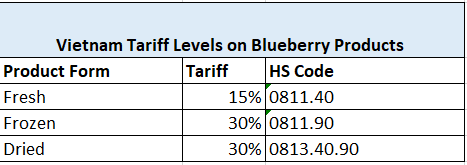
Tariffs:
Picture
Picture

Picture
Picture
California Blueberry Commission
2565 Alluvial Ave. Suite 152
​Clovis, CA 93611
Ph: 559-221-1800
​Fax: 559-456-9099

Subscribe to Newsletter
  • Home
  • About Us
    • Market & Exports >
      • Handler Information
    • Industry Members >
      • CBC Business
    • Staff
  • Publications
    • Newsletters
    • Annual Reports
  • Research
  • Consumer
    • History
    • Education
    • Frequently Asked Questions
    • Recipes
    • Helpful Links
    • Meet Our Growers
  • B-MRIC
    • Grower Crop Estimate Survey
  • Export Market Database
  • Contact